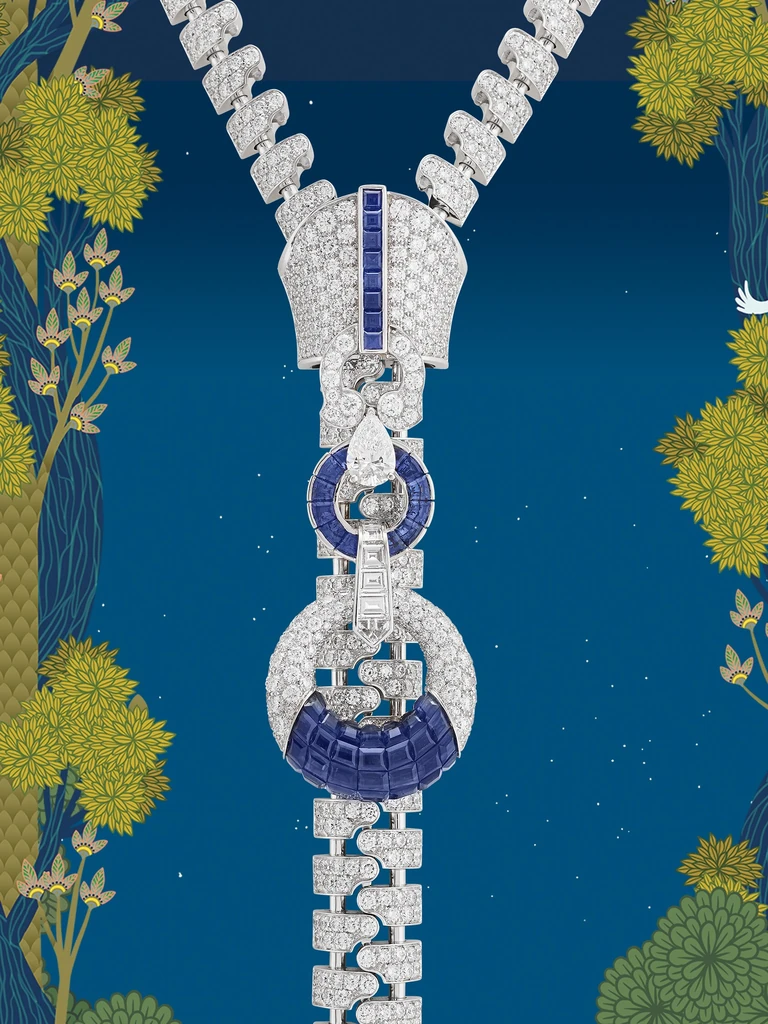
There is a lovely audacity in taking a zipper seriously enough to make it into high jewelry. We know what to do with a slider. The two sides approach each other, the teeth engage and the gap narrows. In the sapphire-and-diamond jewel pictured here, the pull has become an ornament in its own right. I suspect even someone who had never heard of Van Cleef & Arpels would want to see it move.
A zipper before a necklace
Gideon Sundback’s 1917 fastener patent shows the principle in plain view. Two rows enter the wide end of a slider, and a single interlocked row emerges below. Keep that Y shape in mind when you look back at the necklace.

In 1938 Van Cleef & Arpels registered a patent for an ornamental fastener. The house archive records a platinum-and-diamond version and another made for an afternoon dress by Robert Piguet. The fastening still had a garment to close. The more ambitious idea was to let the fastening become the entire jewel.
The first convertible necklace dates to 1950. The Péry workshop filed its patent for the transforming jewel in 1951. Those are separate events. The intervening invention was a way of detaching sections. A necklace that goes around a neck has considerably more length than anyone needs around a wrist. Simply pulling the slider cannot make the excess disappear.
Where the length goes
The house’s account of the assembly describes three sections in the necklace arrangement. An extension goes behind the neck. The center lies open like a zipper partway down a dress. A finishing section attaches at the tassel. Small catches join the sections. To make the bracelet, only the center is needed. Its two rows zip together, and catches on the reverse secure it around the wrist. The slider and the catches do different jobs.
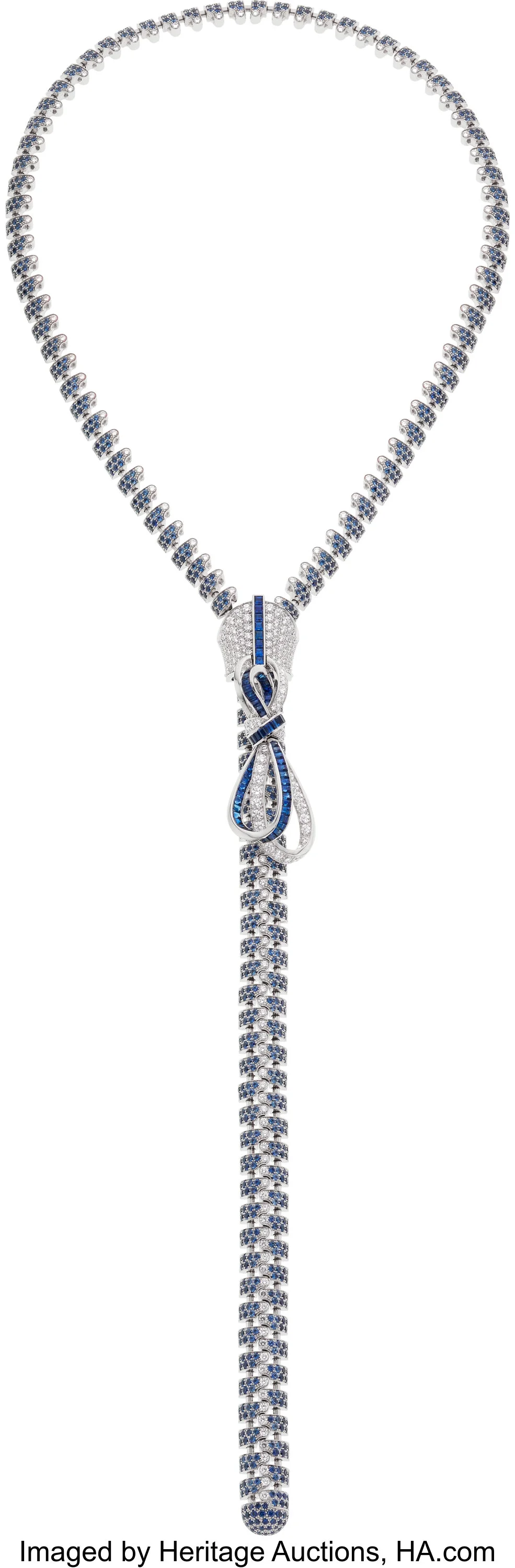
In the full-length photograph, a later white-gold, sapphire and diamond Zip from the Susan Morrow collection hangs open. Follow the two arms from the back of the neck down to the slider. Now compare the 1955 bracelet in the house collection. Around the wrist, the space between the two arms has disappeared. The teeth that drew the eye down a V now run alongside one another in a band. That is what I find so satisfying about the Zip. The teeth have something worth doing in both positions.
The Alhambra spaces its motifs along a chain. The Zip asks rows of individual parts to meet, engage and move together. For anyone drawn to jewelry repair, the archive’s account of the catches offers a small pleasure rarely available in a window display. Turn the jewel over and a second design comes into view, made expressly for the person who must put it on.