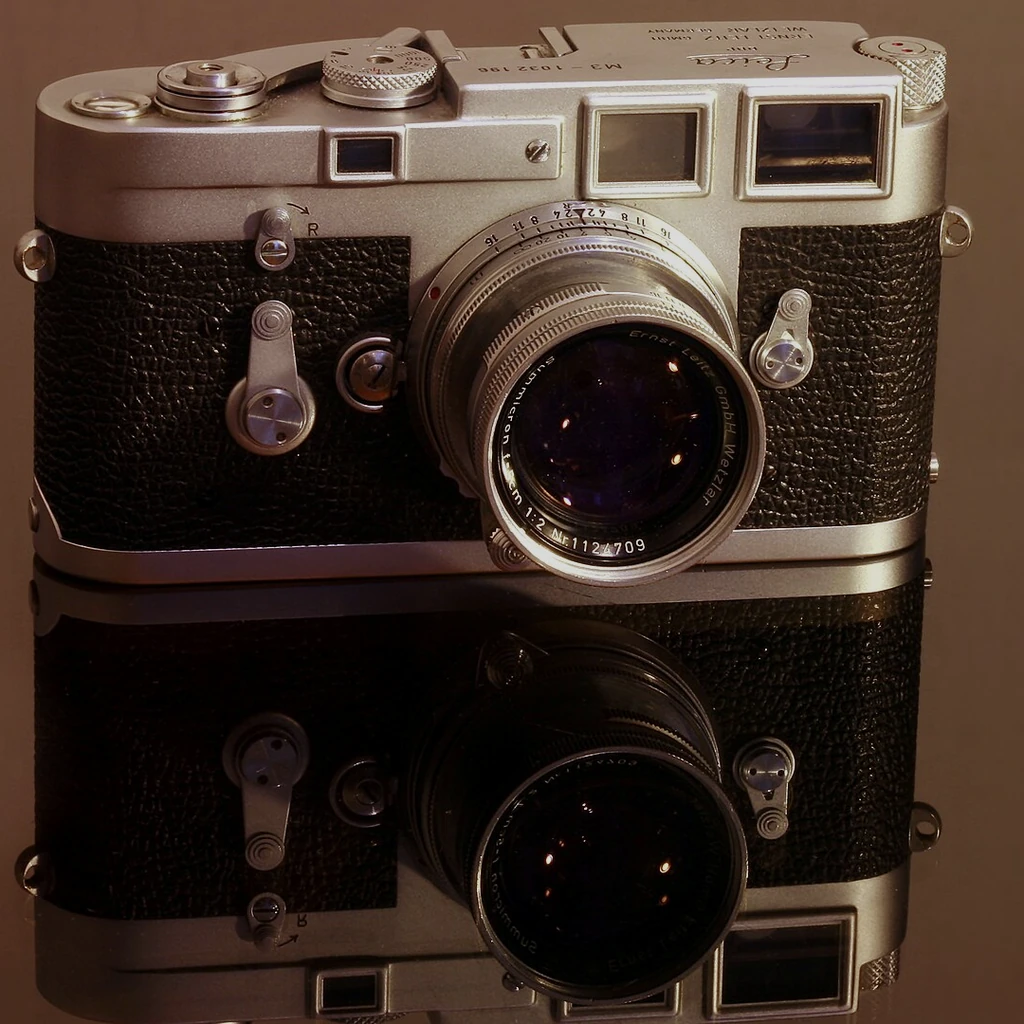

Turn a focusing ring, watch two images coincide, make a photograph. An optical rangefinder Leica M gives that small sequence a central place in the experience. That deliberate participation is why I have selected the M. It gives the act of looking a clear physical form: eye, ring, alignment, release. Across changes from film to digital, there is still an argument here for a camera that makes its user pay attention.
A beginning in 1954
Leica’s historical timeline dates the M3 to 1954. Its combination of a 35 mm camera with a rangefinder became the starting point of the M family. The silver and black camera pictured here belongs to that beginning.
The M-System overview describes manual control and continuity of lenses as central ideas. The family now spans film and digital bodies. A recognizable way of working has persisted through substantial changes in how an image is recorded.
The Porsche 911 poses a related question: how much can change while a familiar way of using an object persists? That is more interesting than the notion of a camera standing outside time. Continuity requires decisions about what to keep and what to change. It also requires some precision when pairing an old lens with a different body.
Looking and taking
On an optical rangefinder M, the viewfinder and the taking lens have different roles. Focusing brings the images in the rangefinder patch into alignment. A demonstration at two distances can make the principle clearer than a lengthy account of the mechanism.
There is a particular satisfaction in an explanation that becomes visible as the listener tries it. A sales advisor needs to give the person enough time to do the trying. Reaching for the camera at every hesitation rather defeats the purpose.
The family also includes cameras with an integrated electronic viewfinder, including the M EV1. An electronic preview and focusing aids offer a different viewing experience, while focus remains manual. “Every M has an optical rangefinder” no longer describes the whole family.
Which photographs?
The most useful question may be what someone wants to photograph. The Montblanc 149 needs paper to explain itself; a camera needs a subject. Street scenes, portraits and close details put different demands on a camera and lens. Familiar focal lengths, working distances and the choice between film and digital give the consultation a direction.
Compatibility deserves the exact lens and body names. Leica’s M-A instructions, for example, set out particular exceptions and restrictions. One body’s manual is not a universal permission slip for the entire system.
I am more interested in what a camera encourages its owner to notice than in a promise that it will improve every photograph. Handling it, making a picture and looking at the result leave room for a personal answer. A patient demonstration can make that answer better informed; it should not decide it in advance.