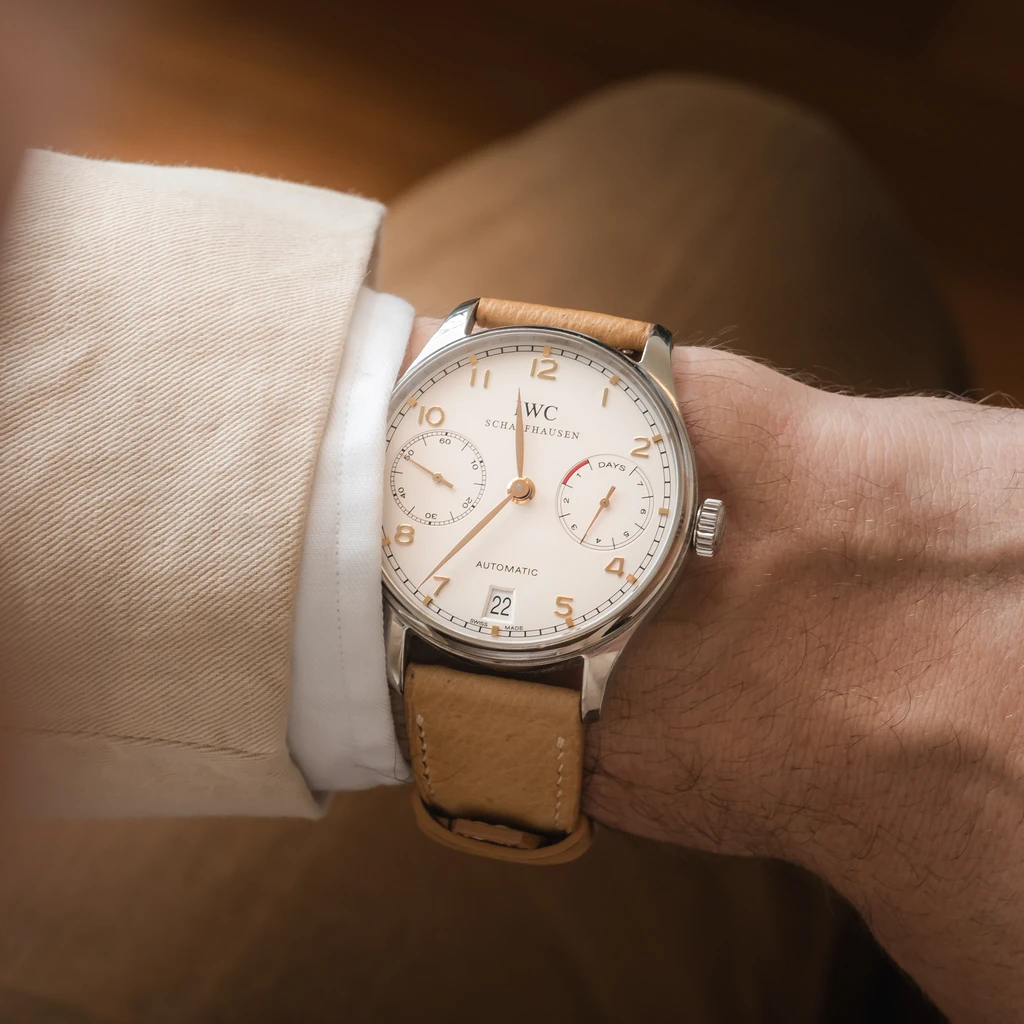
My Portugieser makes room for its dial. It is the steel model, with gold Arabic numerals and hands against a silver-colored face. A small touch of red on the power-reserve subdial gives this otherwise rather composed watch a sporty note. That broad, open face is what draws me in, before counting complications or asking about the movement. I have included it because its generous scale has both a purpose and a personality. The early watches began with movements intended for a pocket; the open dial makes that inheritance visible. Mine carries the idea forward with room for useful information and a little color, without losing its composure.
An old reason for a large watch
IWC traces the family to Portuguese merchants seeking wristwatches with the precision associated with marine chronometers. The early Reference 325 put pocket-watch movements inside a 41.5 mm case. The house’s archival account records the first delivery in 1939, as well as the different dials and movements used during the reference’s life.
That last detail is worth lingering over. A collection’s history rarely reduces to one original picture followed by faithful repetitions. The early watches varied. The 1993 Jubilee model helped renew interest in the family, and later references took its appearance into other kinds of watchmaking.
There is a satisfying continuity here, but it is a continuity of ideas and proportions. A current Portugieser does not acquire a pocket-watch movement or marine chronometer certification simply through ancestry.
What the subdials are doing
The IWC collection history ranges from the time-only anniversary watch to the perpetual calendar. That is quite a distance to travel under one family name. A handsome arrangement of subdials may conceal functions that are very different in use.
On my watch, the small seconds sit opposite a power-reserve indication, with a date window below. The scale runs to seven days; IWC lists a 168-hour reserve for this steel model. The red at the low end is a small, useful interruption to the gold and silver.
A chronograph measures elapsed time. A power-reserve indication tells us how much running time remains before winding is needed. “Chronometer,” despite the similar sound, concerns timekeeping performance. Getting those words straight makes the visible details more enjoyable rather than more forbidding.
I like the moment when a component stops being decoration because someone explains its purpose. A watch specialist can create that moment without requiring the listener to learn the entire vocabulary at once. There is always another question if they want to go further.
The wrist has the final word
The natural peccary strap was crafted for my watch by Atelier Yang in Singapore. Peccary leather comes from a pig-like mammal and has a distinctive grain. Its natural color gives the steel case and gold dial details a warmer companion. It is an aftermarket strap, a choice of mine rather than the watch’s original specification.
The history explains the proportions; it cannot tell us how a particular watch will feel. Lug reach, thickness and the strap all affect the fit. A shirt cuff can settle a question that a specification sheet leaves open.
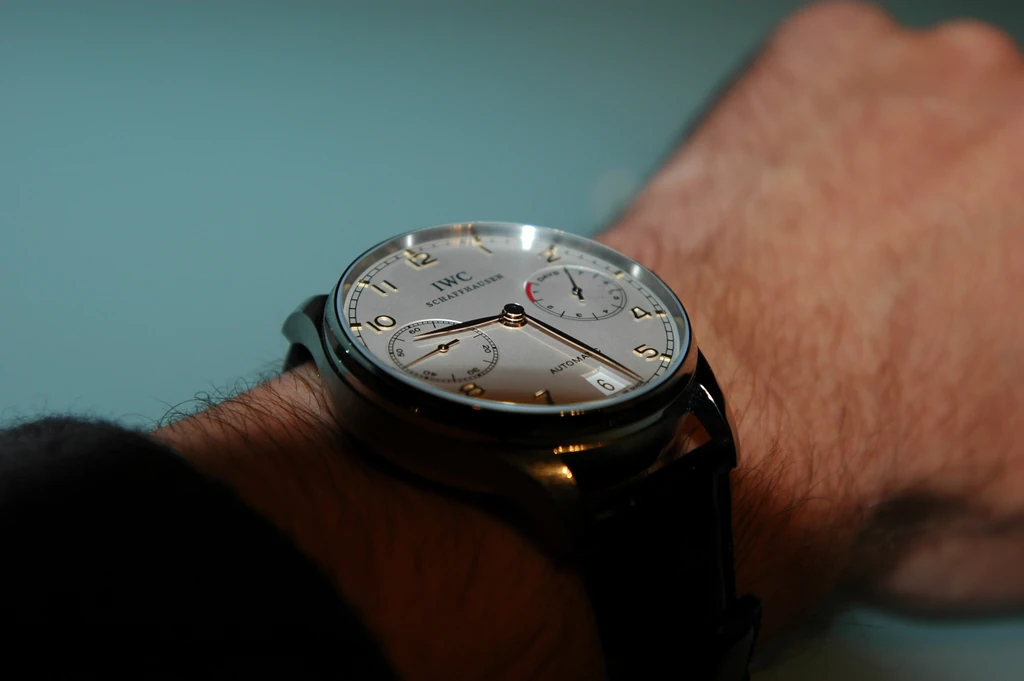
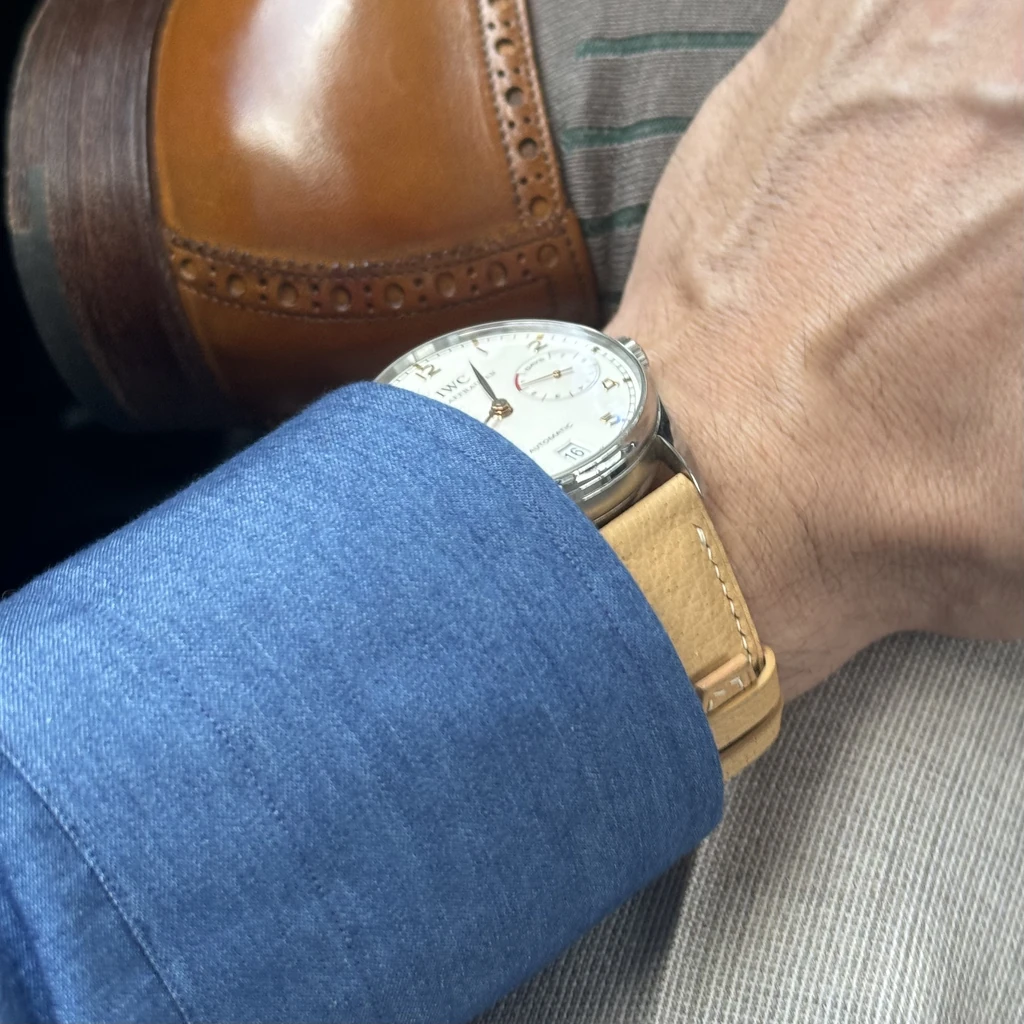
Beside my Calatrava 5026R, the IWC feels generous: more dial, more information, a different presence. The Rolex Submariner puts its useful scale outside the dial, on a rotating bezel. Here the useful extra is inside: how much running time remains. The comparison makes each watch easier to read.
The clarity of those displays should carry through to a demonstration of the controls. An exact reference has exact operating instructions, especially for calendar functions. A question about the mechanism may need a watchmaker; a clear account of its everyday use belongs in the boutique as well. Confidence at the counter includes knowing when to consult them.
For those drawn to work at IWC, the Portugieser offers a rewarding subject: an old practical decision that became an enduring visual language. Begin with the broad dial. The conversation can grow from there.