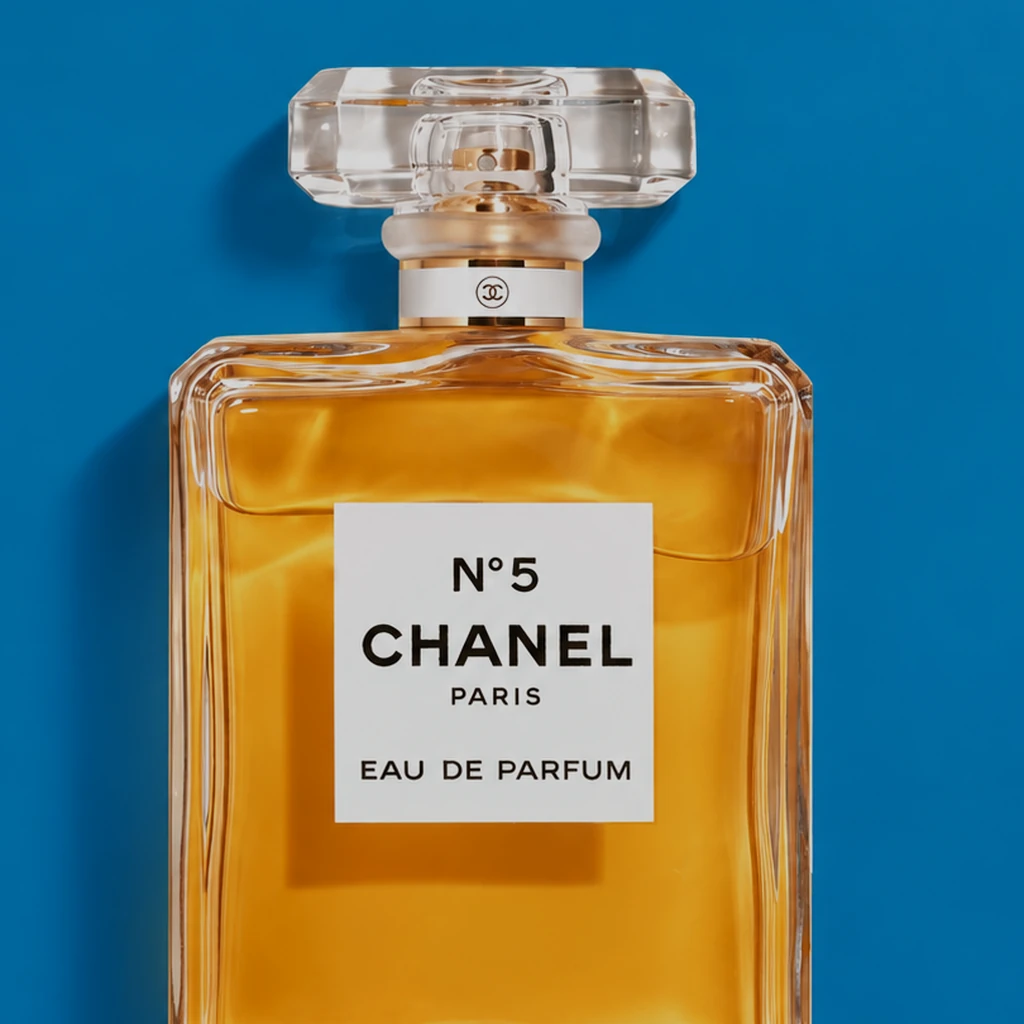
The bottle is almost an argument against ornament: a rectangle, a label, a faceted cap. The fragrance it contains is a much more elaborate proposition. I have chosen N°5 for that tension between a spare, recognizable object and an abstract floral composition. Bottle and fragrance each have an identity strong enough to invite reinterpretation. The object is immediately legible; the scent asks for time.
A flower that does not grow in a garden
Chanel dates N°5 to 1921 and the collaboration between Gabrielle Chanel and Ernest Beaux. In its description of the Parfum, the house explains how aldehydes give the floral composition an airy, abstract character. This is a composed idea of fragrance, rather than an attempt to reproduce one flower literally.
That leaves room for a response that does not sound like the product description. A person may recognize something familiar without being able to name a note. Another may know the bottle perfectly and have no attachment to the scent at all. Neither has failed the encounter.
The 2.55 handbag offers another version of Chanel’s economy of recognition: a few details establish the family, then the individual piece asks for a closer encounter. Fragrance makes an unusually personal meeting between an object and a memory. The person at the counter has to leave space for both.
Which N°5?
The familiar number can conceal a surprisingly important question. Jacques Polge created the Eau de Parfum in 1986 as a reinterpretation of Beaux’s composition. Chanel identifies rose, jasmine and aldehydes in its description. Eau Première, introduced in 2008, is another interpretation.
“Stronger” and “weaker” are insufficient ways of explaining the family. These are distinct versions, and the exact name matters. A gift buyer replacing a much-loved bottle needs to bring home the right one, not simply a box with the right number.
A photograph of the old bottle may do more useful work than an elaborate account of perfume history. There is something rather reassuring about expertise that knows when to ask for a photograph.
Let it develop
A beauty advisor’s consultation should have some breathing room. A small selection on labeled blotters gives each trial an identity; a skin trial, with permission, lets the person consider it differently. Returning to a sample after a little time can change the conversation.
I would be wary of an advisor who supplied my response before I had one. The vocabulary of fragrance is there to help articulate an impression, not to overrule it. Nor does a famous name justify promises about an exact number of hours of wear, or rules about who is the right age to wear it.
“This is not the N°5 I remember” is an interesting beginning. It calls for product knowledge, certainly, but also patience with the memory itself. For people considering fragrance roles at Chanel, that combination is as much a part of the product as anything written on its box.