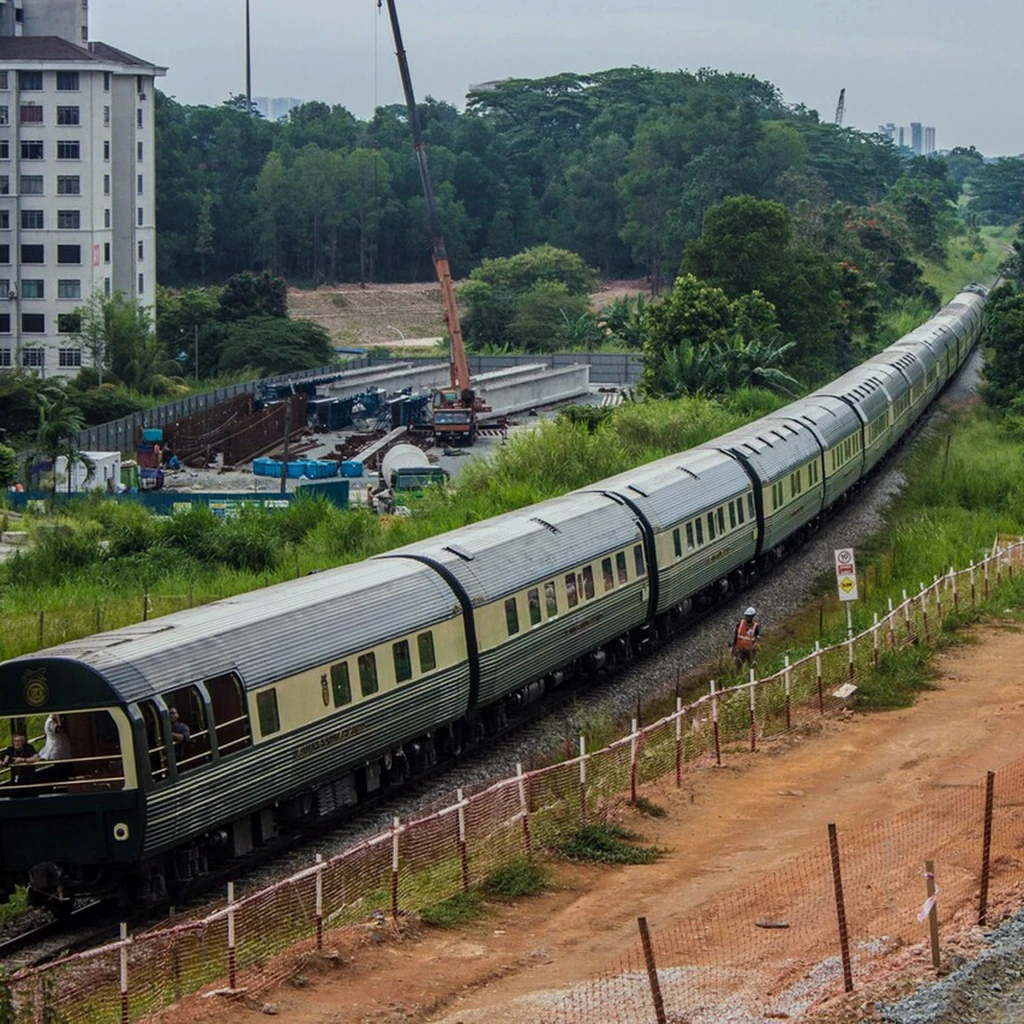

A luxury train asks us to reconsider the usual point of transport. Getting there is allowed to take time. The view changes while the room stays with us; dinner and an hour in the observation car become part of the reason for traveling. I have included the Eastern & Oriental Express because it gives that idea a complete, recognizable form: carriage, room, meal and landscape become one experience. It earns its place here by making the journey itself worth our attention.
A journey with a name
Belmond dates the train’s first journeys to 1993. Its presentation of the service describes departures from Singapore into Malaysia, with dining cars, a piano bar and an observation car. The green and cream carriages in the photograph belong to that recognizable identity; the picture itself was taken in Johor Bahru in 2019.
Names gather associations. The literary origin of Montecristo is one example elsewhere in this collection; a train’s name can similarly arrive carrying a story before we know the particulars. A familiar train name can make different journeys seem interchangeable. They are not. Routes, stops and inclusions belong to a particular departure, and old accounts are part of the history rather than instructions for a new reservation. The romance of rail travel is better served by getting the station right.
A room that changes overnight
The accommodation guide makes the cabins especially interesting. Pullman seating converts to upper and lower berths; a State Cabin converts to two twin beds. Presidential Suites provide more space. Within a fixed carriage, the room performs more than one job.
I find the day-to-night transformation a more revealing explanation than the category names alone. How will two people sit together? How will they sleep? Where will their things go? These are modest questions, but they determine how easily someone inhabits the experience.
They also give a reservations advisor a chance to be specific. A layout is more helpful than “more comfortable,” particularly where access to a bed matters. Mobility requirements need an answer from the people who know the train and its excursions; a larger room is not, by itself, that answer.
The work before departure
Much of good hospitality happens before the guest notices it. Belmond’s frequently asked questions address facilities and luggage arrangements. Behind a well-prepared stay are similarly unglamorous details: what remains in the cabin, what is stored elsewhere, what the kitchen has confirmed and which transfer is arranged.
There is a substantial difference between “the guest has requested” and “we have confirmed.” Anyone who has to carry a request across departments needs to keep that distinction intact. The guest should encounter the result, not the effort of reconstructing the conversation.
That is what makes this train an interesting lens on work at Belmond. The Porsche 911 puts the pleasure of travel in the driver’s hands; this train entrusts it to the people looking after the passenger. The public image is an elegant journey. Delivering it depends on many precise, connected acts of service. Each vacancy has its own property and location, of course; the train is one expression of a much wider hospitality world.